The James Webb Space Telescope has provided a definitive explanation for the mysterious, blood-red objects that have appeared in deep-field images since the observatory began its mission in 2022. A study published July 29, 2026, in The Astrophysical Journal confirms that these so-called little red dots are not exotic phenomena, but rather supermassive black holes undergoing periods of intense growth.
Pierluigi Rinaldi, a researcher at the University of Arizona’s Steward Observatory and the Space Telescope Science Institute, led the team that identified the key to this cosmic puzzle. By analyzing a spiral galaxy nicknamed the Saguaro, located at a redshift of 2, the researchers observed a structure that matches the characteristics of a little red dot when viewed from a distance. This galaxy, formally catalogued as WISEA J123635.56+621424.2, allowed the team to distinguish between the luminous, compact core and the surrounding galactic disk.
The investigation utilized spectroscopic data captured by the telescope’s NIRSpec microshutter arrays, which were precisely aligned over the galaxy’s core to isolate its light. This alignment captured high-resolution data that would typically require dedicated, multi-hour observation windows to obtain for such faint targets. The resulting spectra revealed the characteristic V-shaped profile associated with these objects, indicating that the nucleus is significantly brighter in ultraviolet and infrared wavelengths than in visible light.
The team also incorporated data from NASA’s Chandra X-ray Observatory, which detected weak X-ray emissions from the Saguaro’s core. This combination of heavy dust obscuration and low-level X-ray output provides a consistent model for why these objects appear as they do in the early universe. It explains the lack of X-ray detection in other, more distant samples, as the signal is often too faint to penetrate the dense, surrounding gas cocoons.
Previous concerns that these dots signaled a failure of standard cosmological models stemmed from an observational bias. Early estimates suggested that these objects were far more massive than standard models predicted, but subsequent analysis has corrected these figures. A January 2026 study in Nature by Rusakov and colleagues demonstrated that the dense gas cocoons surrounding these black holes artificially broadened spectral lines, leading to an overestimation of their mass by a factor of approximately 100.
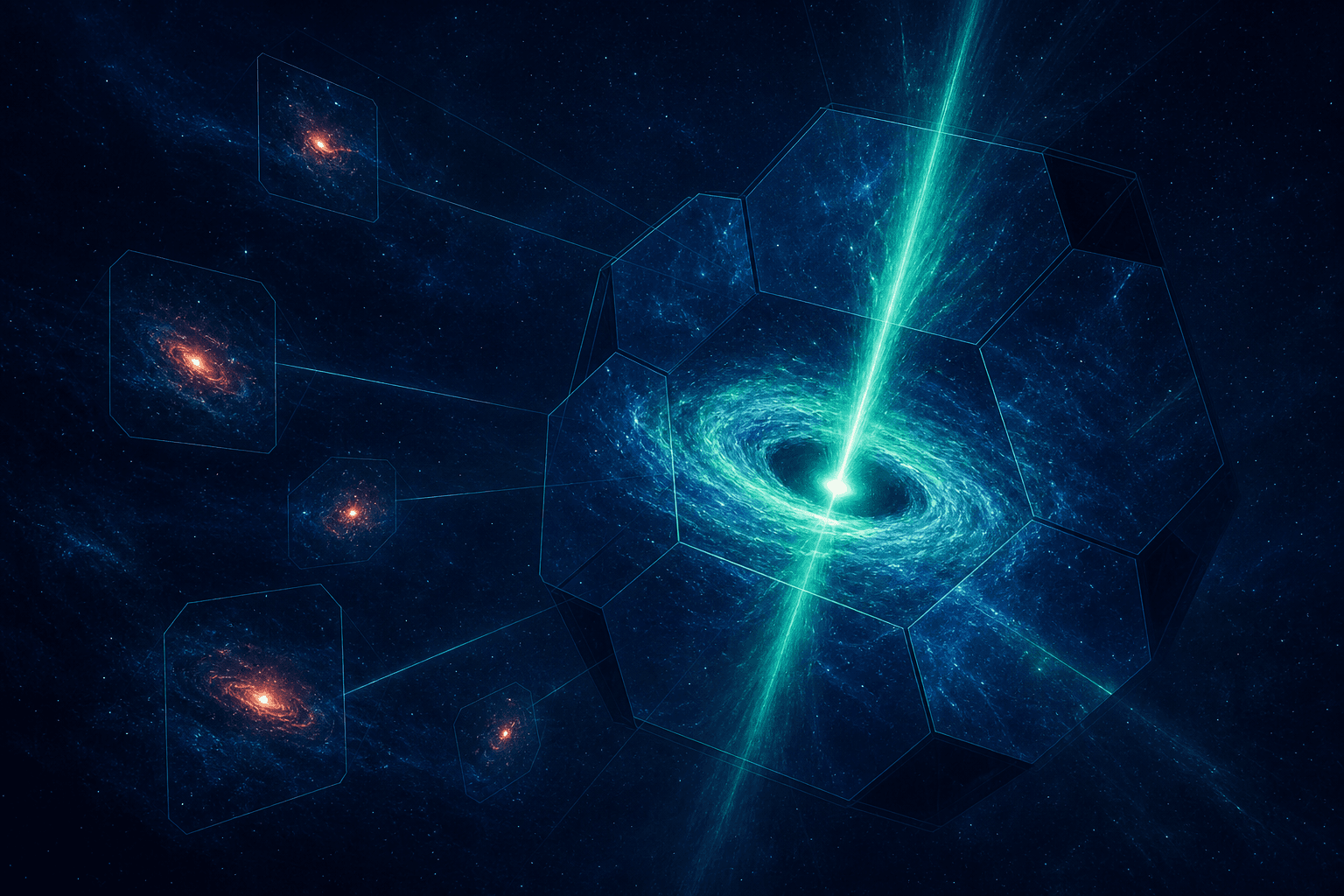
The Rinaldi team conducted a simulation to determine how the Saguaro would appear if it were moved to the high-redshift distances where most little red dots reside. The results showed that the extended spiral arms and star-forming regions would fall below the telescope’s detection threshold, leaving only the compact, luminous nucleus visible. This empirical demonstration confirms that the dots are not isolated entities but rather the visible centers of galaxies that are otherwise too faint to be seen at extreme distances.
The physical mechanism driving this effect is a fundamental property of an expanding universe known as cosmological surface brightness dimming. Extended objects lose brightness proportional to the fourth power of their redshift, while point sources like active galactic nuclei dim much more slowly. This disparity ensures that the central engines of these galaxies remain detectable long after their host structures have faded from view, creating an illusion of isolated, compact objects.
These findings suggest that little red dots represent a specific, high-activity phase in the evolution of supermassive black holes. During this period, the black holes feed at super-Eddington rates while cloaked in heavy dust. As the surrounding gas supply is exhausted and the dust clears, these objects likely transition into the more quiescent central black holes observed in modern spiral galaxies.
Understanding this transition provides a clearer view of how galaxies and their central black holes co-evolve over cosmic time. By identifying the Saguaro as a local analog, researchers have established a template for tracking the life cycle of these objects. Future observations will focus on identifying the progeny of these early black holes to map their development from high-redshift, dust-shrouded engines to the stable structures found in the local universe.