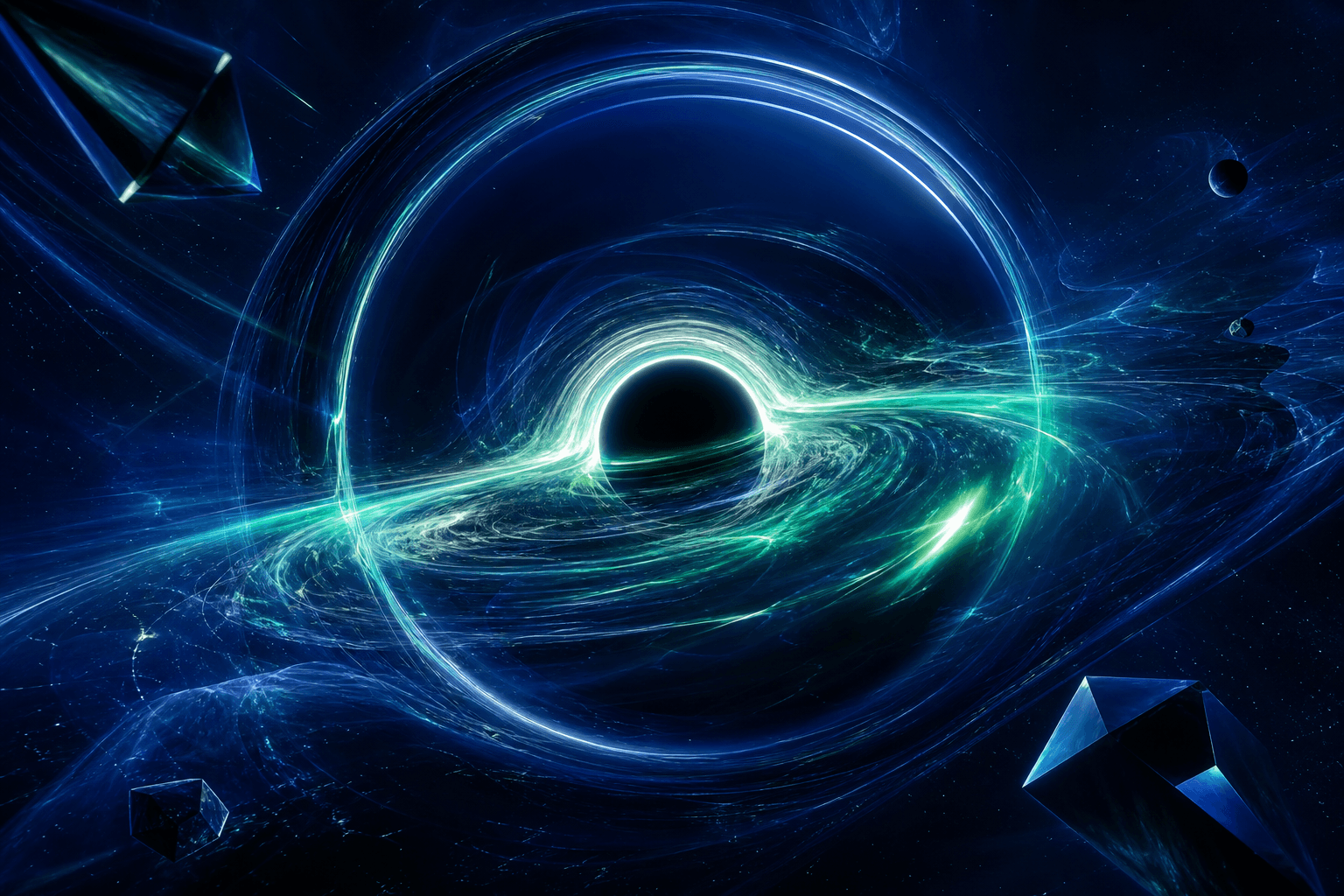
Astronomers using the James Webb Space Telescope have identified a celestial object that defies traditional classification by combining the characteristics of a black hole and a star. Designated as MoM-BH*-1, this hybrid entity exists roughly 660 million years after the Big Bang and presents a unique spectral signature that challenges existing models of early cosmic evolution.
The discovery emerged during the Mirage or Miracle survey, an initiative designed to catalog the earliest galaxies in the observable universe. Researchers initially identified the object as one of the mysterious little red dots frequently observed in early-universe data, yet its spectral profile revealed a uniquely deep Balmer break. This specific light signature, characterized by an abrupt disappearance of light below a certain wavelength, cannot be explained by standard stellar physics or the presence of interstellar dust.
Rohan Naidu, the lead author of the study and a researcher formerly at the MIT Kavli Institute for Astrophysics and Space Research, spearheaded the analysis of this phenomenon. The team determined that the object consists of a central black hole with a mass approximately 100,000 times that of the sun, encased in a massive envelope of dense hydrogen and helium gas. This gaseous shell, which spans the diameter of the solar system, functions as a pseudo-photosphere that absorbs and re-radiates energy generated by the black hole.
The energy output of MoM-BH*-1 is estimated to be 100 billion times greater than that of a typical star, a level of power that cannot be sustained through nuclear fusion. Instead, the gravitational energy released by the accreting black hole drives the intense luminosity observed by the telescope. Simulations conducted by the team confirmed that a dense screen of hydrogen is capable of producing the observed red color and brightness without the need for dust contamination.
Robert Simcoe, director of the MIT Kavli Institute, noted that the density of the hydrogen screen allows the object to mimic the surface of a massive star despite its fundamentally different energy source. This finding suggests that the object is not a star in the traditional sense, but a black hole undergoing a rapid growth phase obscured by its own gaseous cocoon. The research, which appears in the journal Nature, provides a potential mechanism for how supermassive black holes achieved such significant mass shortly after the dawn of the universe.
The existence of MoM-BH*-1 suggests that many of the little red dots identified in previous surveys may represent a common stage in the development of massive galaxies. These objects likely act as seeds for supermassive black holes, regulating star formation in their host galaxies while simultaneously growing through efficient gas accretion. This phase may represent a critical, swaddled period in the lifecycle of almost every supermassive black hole, dictating the subsequent formation of stars and planetary systems.
The significance of this discovery lies in its ability to resolve the discrepancy between theoretical models and observational data regarding early black hole formation. Previous theories predicted that supermassive black holes required billions of years to reach the sizes observed at high redshifts, yet the existence of these hybrid objects offers a pathway for accelerated growth. By providing a fast-track channel for mass accumulation, black hole stars may explain why massive structures appeared much earlier in the cosmic timeline than previously anticipated.
Future research will focus on identifying additional siblings of MoM-BH*-1 to confirm the prevalence of this hybrid state across the early universe. The team has scheduled follow-up observations with the James Webb Space Telescope for December to analyze spectral variability and multi-wavelength data. These upcoming investigations aim to determine whether the black hole star phase is a universal feature of early galaxy evolution or a specific phenomenon limited to certain environments.
The scientific community remains cautious, acknowledging that further evidence is required to fully validate the model across the broader population of red objects. Researchers will continue to test the hypothesis against new data, searching for X-ray or radio counterparts that would confirm the presence of an active, accreting black hole core. The transition from a black hole star to a standard quasar remains a key area of study, as astronomers seek to understand the long-term evolution of these enigmatic cosmic structures.