Astronomers have identified a mechanism involving powerful gaseous outflows that explains the unexpected prevalence of massive, inactive galaxies in the early universe. Published June 10 in the Monthly Notices of the Royal Astronomical Society, the findings provide a structural explanation for why certain galaxies cease star formation shortly after their initial development.
The research team, led by Dr. Rebecca Davies of Swinburne University of Technology, utilized the James Webb Space Telescope to observe the galaxy system designated CRISTAL-02. This system, located approximately 1 billion years after the Big Bang, is currently undergoing a period of rapid stellar formation driven by cosmic collisions. Associate Professor Deanne Fisher collaborated on the study, which sought to reconcile current observational data with existing models of galactic evolution.
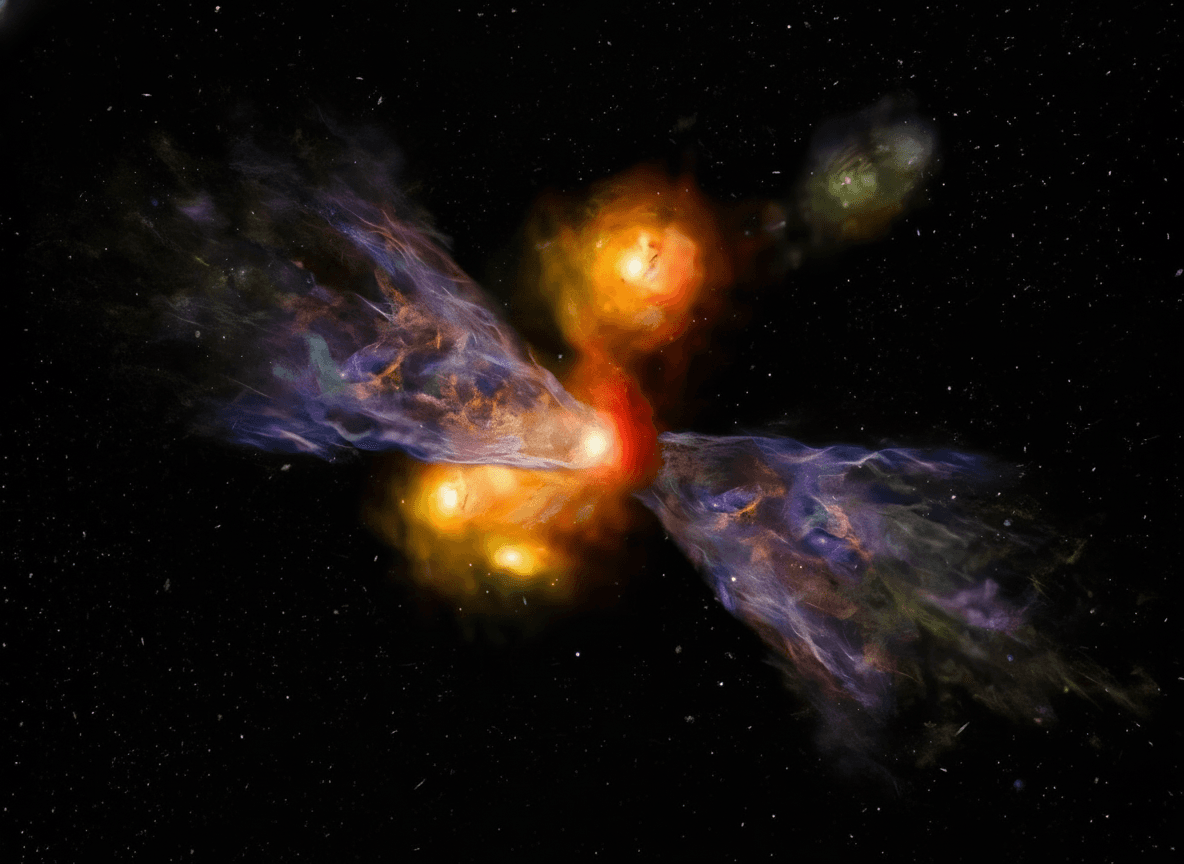
Observations indicate that the intense star formation within CRISTAL-02 is accompanied by the expulsion of cold gas at high velocities. This material extends in a plume nearly equal to the length of the galaxy itself, marking a clear departure of essential star-forming fuel. The data suggests that the rate of gas ejection is double the rate at which the galaxy consumes gas to create new stars.
The study utilized both the James Webb Space Telescope and the Atacama Large Millimeter/submillimeter Array to capture the multiphase nature of these winds. These instruments allowed the researchers to track the movement of gas with enhanced sensitivity. The resulting imagery confirms that the wind is a direct consequence of the same processes that drive the galaxy’s rapid growth phase.
The researchers mapped the gas distribution across the system to understand the physical extent of the outflow. By analyzing the velocity and density of the plume, the team confirmed that the wind is sufficient to strip the galaxy of its remaining star-forming potential. This process effectively halts the creation of new stars, leading to the rapid transition into a quiescent state.
Dense regions of the universe are like very active cities. Galaxies collide and undergo frenzied bursts of star formation. But when the biggest stars burn out, they explode as supernovas, launching powerful winds that blast away the very gas galaxies need to keep forming stars.
Dr. Davies noted that the rapid blowout observed in CRISTAL-02 could exhaust the galaxy’s fuel reservoir within 50 million years. This timeline provides a plausible explanation for the existence of massive, quiescent galaxies that appear fully formed at such an early stage of cosmic history. The research suggests that the lifecycle of these objects is characterized by a brief, high-intensity period of growth followed by a swift transition to a dormant state.
The prevalence of such interactions suggests that this phenomenon is not an outlier but a standard evolutionary path for massive structures in the early universe. Approximately half of the massive galaxies observed in this epoch exhibit signs of interaction with neighboring systems. This high frequency of collision-induced star formation and subsequent wind-driven quenching points to a widespread regulatory mechanism in early galactic development.
This discovery challenges previous hypotheses that relied on variations in dark energy to explain the rapid maturation of early galaxies. By identifying a localized, supernova-driven process, the researchers have provided a more parsimonious explanation for the observed data. The findings shift the focus toward the internal dynamics of galactic collisions rather than external cosmological variables.
Future observations will likely focus on identifying similar wind signatures in a broader sample of early-universe galaxies to confirm the universality of this mechanism. Researchers aim to determine if the duration of these star-formation bursts varies significantly across different galactic environments. These upcoming studies will refine the timeline of early galaxy evolution and provide further clarity on how the universe transitioned from its initial state to the structured cosmos observed today.