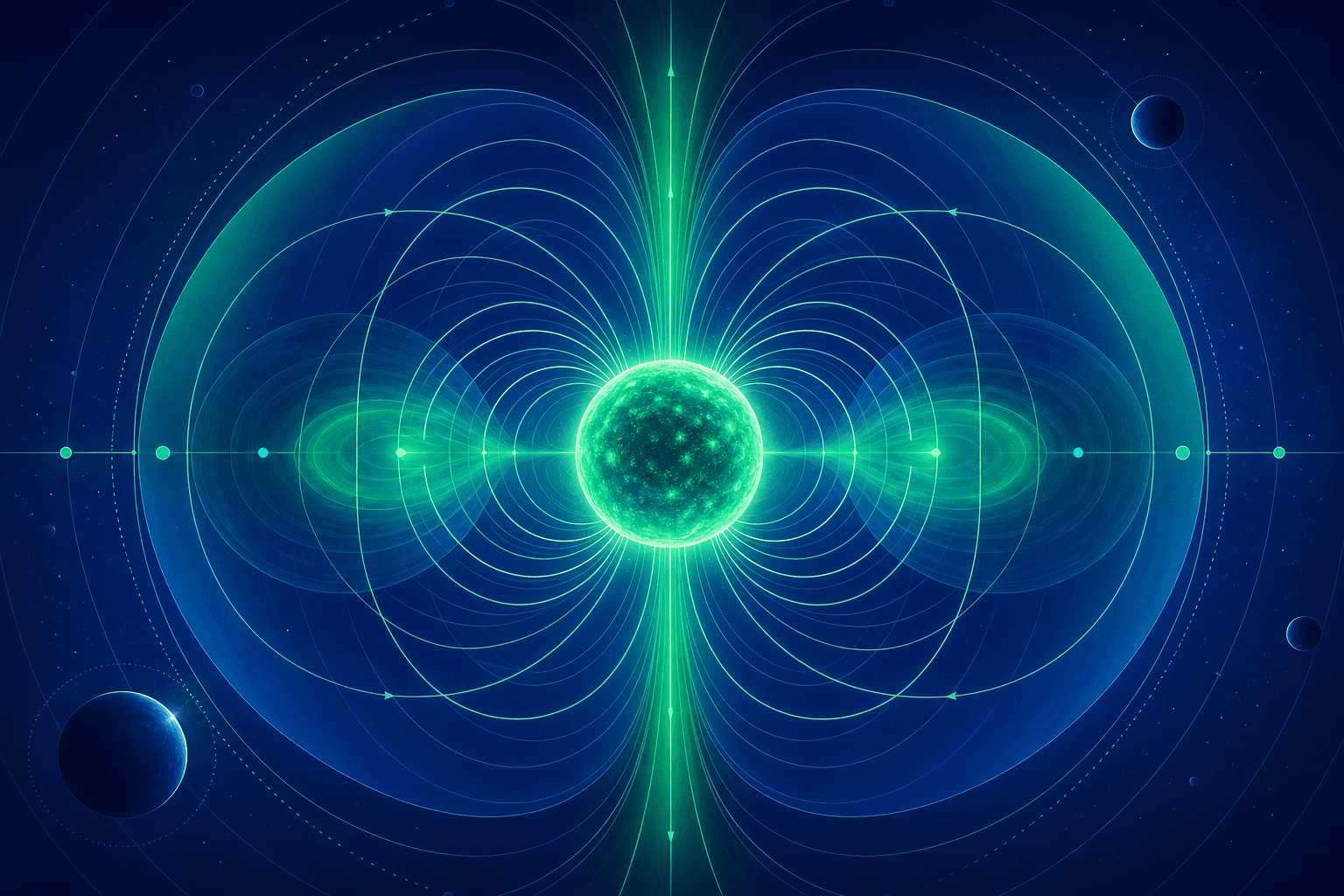
Stellar activity often includes the ejection of charged particles into space, yet these events remain elusive when observing stars beyond our own solar system. A recent experimental study indicates that strong magnetic fields surrounding certain stars may effectively trap or dissipate these plasma outbursts before they escape into the interstellar medium.
Researchers published these findings in a paper accepted to Physical Review Letters, detailing how controlled magnetic environments influence the trajectory of plasma streams. The study suggests that coronal mass ejections—the massive clouds of ionized gas typically associated with solar flares—might be suppressed by the very magnetic forces that define a star’s environment. Joe Callingham, an astronomer at the University of Amsterdam who was not involved in the research, noted that this evidence provides a compelling explanation for why such eruptions are rarely detected on active stars. Understanding this suppression is critical for evaluating the habitability of exoplanets, as frequent plasma bombardment can strip a world of its atmosphere.
Astronomers have long sought to identify coronal mass ejections on stars that exhibit high levels of flaring activity. Despite these efforts, evidence of such ejections remains limited to a small number of observed stars, creating a discrepancy between theoretical expectations and observational data. Julián Alvarado Gómez, an astrophysicist at the Leibniz Institute for Astrophysics Potsdam in Germany, hypothesized that these highly active stars operate within a physical regime distinct from the sun. This observation prompted a collaborative effort with plasma physicists to investigate the interaction between magnetic fields and plasma streams under laboratory conditions.
The team utilized high-energy lasers to launch plasma streams into magnetic fields of varying intensities at the Extreme Light Infrastructure – Nuclear Physics facility in Măgurele, Romania. Plasma physicist Sophia Chen observed that while weak magnetic fields allowed the plasma to propagate without significant interference, higher field strengths induced a dramatic change in behavior. The plasma streams branched out and eventually halted, often curling back toward the source rather than continuing their outward path. Computer simulations indicated that a phenomenon known as kink instability was responsible for these sharp directional shifts.
Mathematical scaling relationships suggest that these laboratory-scale observations are applicable to the physics governing massive stars. Although the experiment does not perfectly replicate the complex magnetic loops found in stellar coronas, it provides a functional model for how magnetic structures influence plasma dynamics. The researchers acknowledge that real-world coronal mass ejections carry their own tangled magnetic fields, which adds a layer of complexity not fully captured in the current experimental setup. This laboratory work serves as a bridge between small-scale plasma physics and the large-scale phenomena observed in deep space.
The experimental results demonstrate that magnetic field intensity acts as a primary gatekeeper for stellar mass loss. By analyzing how plasma responds to external magnetic pressure, the team has identified a mechanism that likely prevents the escape of ionized material from the stellar surface. This finding helps reconcile the lack of observational evidence for coronal mass ejections on stars that possess the necessary energy to produce them. The study effectively shifts the focus of stellar research toward the role of magnetic topology in regulating atmospheric loss.
Future research will require more extensive observational data to confirm how these magnetic mechanisms manifest across different stellar types. Callingham, who participated in a 2025 study that identified a coronal mass ejection on a distant star, emphasized that the duration of observations remains a limiting factor in current surveys. Determining whether a star is a suitable host for life necessitates a comprehensive understanding of its eruptive behavior and magnetic environment. This research represents a significant step in the ongoing effort to characterize stellar environments and their impact on planetary evolution.
The findings underscore the necessity of integrating plasma physics with stellar astronomy to refine models of stellar evolution. As observational techniques improve, the scientific community will likely gain clearer insights into how magnetic confinement dictates the flow of energy and matter from a star’s surface. These developments remain essential for characterizing the environments of potentially habitable worlds orbiting active stars.