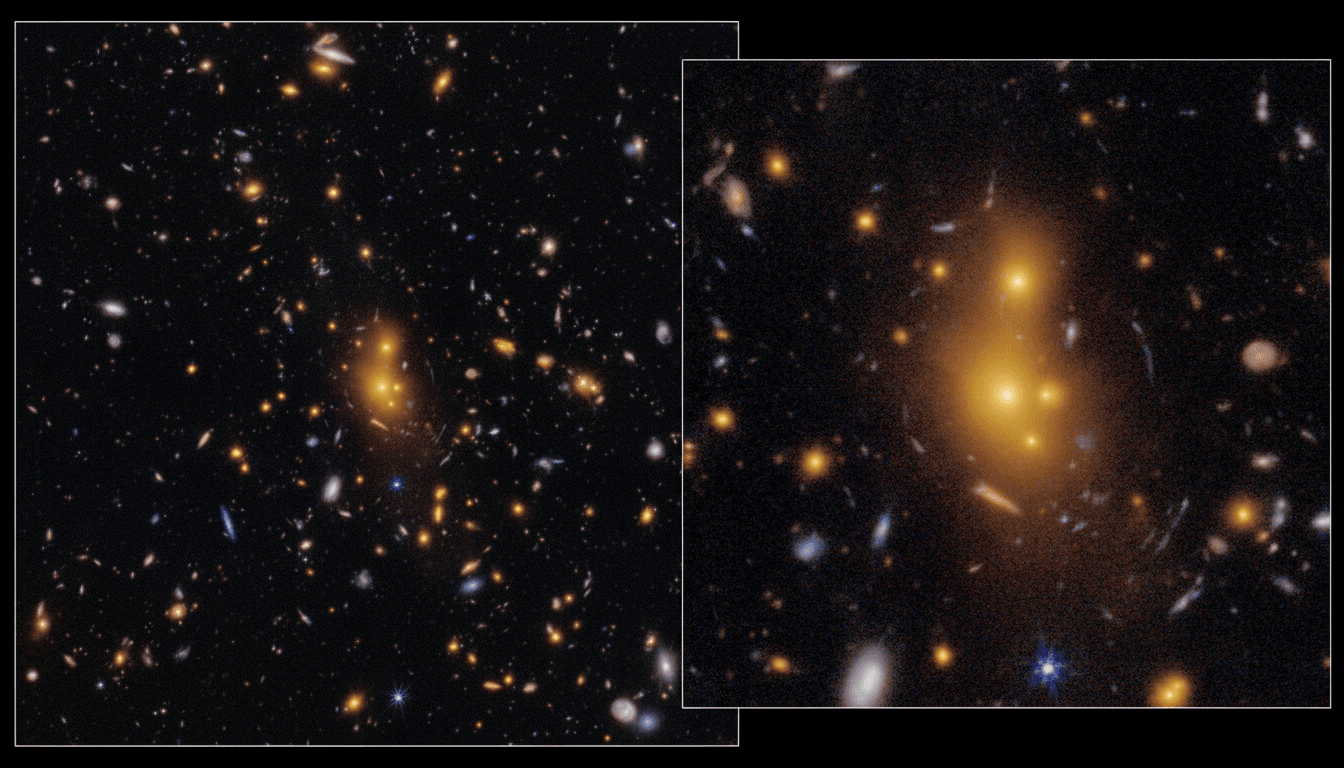
Astronomers have identified a galaxy cluster, designated XLSSC 122, that exhibits a level of maturity and mass concentration inconsistent with current models of cosmic evolution. Located approximately 10.4 billion light-years away, this structure dates back to the era known as cosmic noon, a period when the universe was characterized by intense star formation and the initial assembly of large-scale galactic groupings.
The research team, led by scientists at the IPAC science and data center at Caltech, utilized the James Webb Space Telescope to capture high-resolution imagery of the cluster. These observations confirmed that XLSSC 122 acts as a strong gravitational lens, warping the light of more distant galaxies positioned behind it. This phenomenon, which was not detectable in previous surveys by the Hubble Space Telescope, provides a precise method for calculating the cluster’s total mass.
Kyle Finner, a staff scientist at IPAC and lead author of the study, noted that the cluster’s mass distribution is heavily concentrated toward its center. This configuration suggests that the cluster reached a state of advanced organization much earlier than conventional cosmological frameworks predict. The findings were formally presented at the 248th meeting of the American Astronomical Society and published in The Astrophysical Journal Letters.
The research effort expanded into a series of three papers, with subsequent studies co-authored by Zachary Scofield and Hyungjin Joo of Yonsei University. These investigations employed both strong and weak gravitational lensing techniques to map the distribution of matter across the cluster’s periphery. The data indicate that the cluster is currently in a state of active merger, with constituent galaxies still coalescing under gravitational influence.
A critical component of this analysis involved detecting intracluster light, which consists of stars drifting between galaxies within the cluster. The team observed that the spatial distribution of this light aligns closely with the concentration of dark matter inferred from gravitational lensing. This correlation suggests that intracluster light may serve as a reliable proxy for mapping dark matter in distant, early-universe structures.
The researchers also integrated X-ray and radio wave data from other observatories to build a comprehensive profile of the cluster’s environment. This multi-wavelength approach confirmed that the cluster is not merely a static object but a dynamic system in the midst of a significant growth phase. By synthesizing these diverse datasets, the team established that the cluster’s internal structure is far more complex than initial X-ray surveys from 2014 had suggested.
Dark matter remains the primary driver of the gravitational effects observed in XLSSC 122, as it accounts for the vast majority of the cluster’s mass. Because dark matter does not interact with electromagnetic radiation, researchers rely on its gravitational signature to understand its role in the formation of the universe’s large-scale filaments. The ability to measure this invisible substance through lensing provides a rigorous test for existing cosmological simulations.
The existence of such a highly evolved cluster at this stage of cosmic history suggests that the mechanisms governing structure formation may be more efficient than previously understood. If additional clusters with similar characteristics are identified, cosmologists may need to revise foundational theories regarding the timeline of the universe’s development. The current data indicate that the standard model of structure growth faces significant pressure from these early, massive objects.
This discovery highlights the limitations of current cosmological models that assume a slower, more gradual buildup of matter in the early universe. By demonstrating that massive, concentrated clusters existed 10 billion years ago, the study forces a reassessment of the density fluctuations that seeded the cosmos. The findings underscore the necessity of incorporating high-resolution lensing data into future simulations of the early universe.
Future research will depend on identifying more candidates through wide-area surveys, particularly those utilizing X-ray data and the Sunyaev–Zel’dovich effect. By analyzing the cosmic microwave background for specific signatures of galaxy clusters, researchers hope to build a larger sample size of cosmic noon structures. Expanding this dataset will be essential to determine whether XLSSC 122 is an outlier or representative of a broader, unrecognized trend in early galaxy formation.