Astronomers have identified one of the most powerful ultra-fast outflows ever documented, originating from a supermassive black hole located at cosmic noon. The research team, led by Giorgio Lanzuisi of INAF Bologna, utilized data from the XMM-Newton and NuSTAR space observatories to characterize the energetic gas emissions from the quasar known as WISSH13.
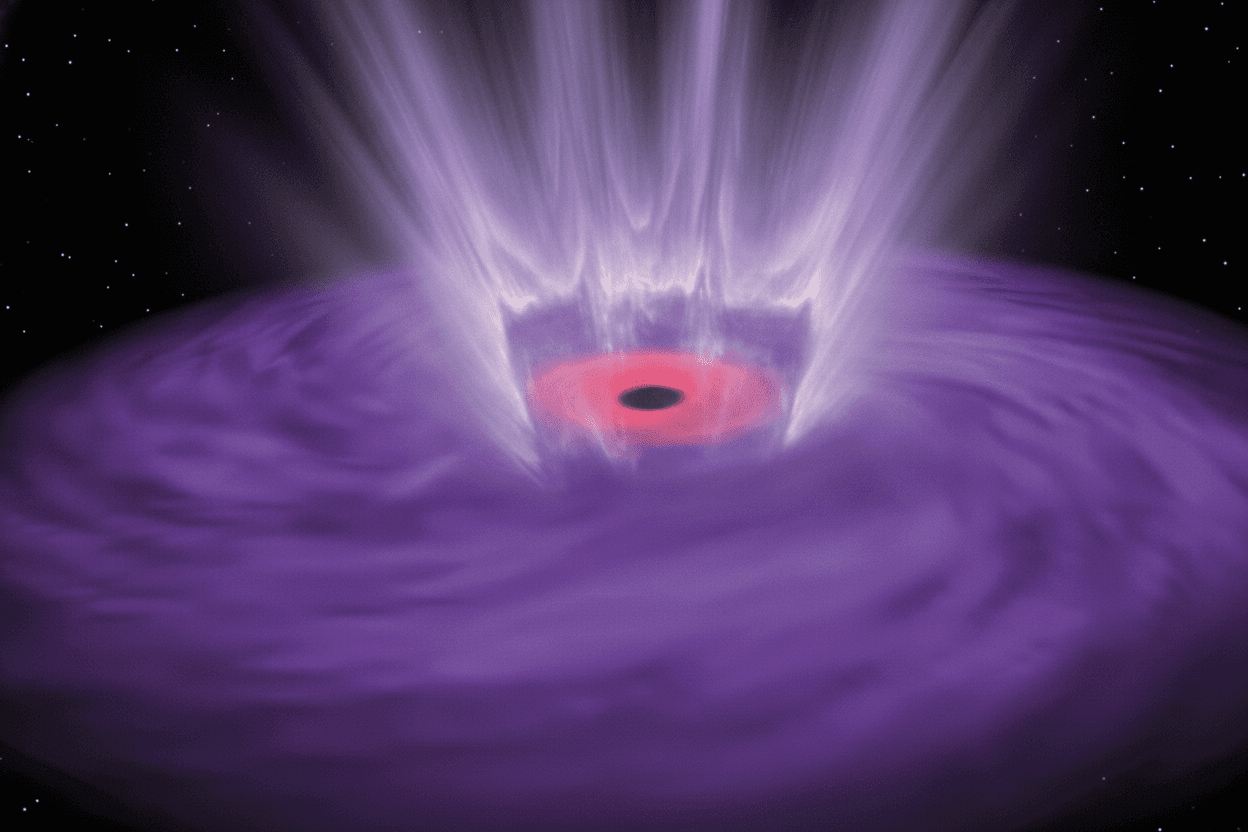
Black holes that consume significant quantities of matter frequently generate intense winds of gas that blast outward from the vicinity of the accretion disk. These phenomena are classified as ultra-fast outflows when the velocity of the gas exceeds 10% of the speed of light. Such outflows serve as a primary mechanism for black holes to modulate both their own growth and the development of their host galaxies. By injecting substantial energy into surrounding gas, these winds heat the environment, inhibit star formation, and can eventually lead to the total quenching of a galaxy. This regulatory process typically occurs during cosmic noon, a period spanning 1.6 to 3.5 billion years after the Big Bang characterized by peak growth rates for both galaxies and their central black holes.
The research team identified the presence of these outflows through absorption features within X-ray spectra. Highly ionized iron atoms in the outflowing gas absorb X-rays, creating distinct dips in the observed spectrum. Because this gas moves at a significant fraction of the speed of light, these absorption features appear blueshifted toward higher energies. While previous high-redshift detections relied on gravitationally lensed quasars, the WISSHFUL program specifically targets non-lensed, ordinary quasars to avoid the uncertainties introduced by magnification.
The target, WISSH13, is situated at a redshift of 3.294, representing the state of the system approximately 2 billion years after the Big Bang. The central black hole possesses a mass roughly 2 billion times that of the sun and exhibits a luminosity three times higher than standard models predict for an object of its size. By synthesizing archival XMM-Newton data from 2017 with new observations from October 2024, the researchers constructed a high-quality X-ray spectrum revealing two distinct absorption components. Modeling indicates that these features correspond to two separate components of a single outflow, traveling at approximately 10% and 30% of the speed of light.
The spectral analysis relied on identifying specific absorption lines from highly ionized iron, which provided the necessary precision to calculate the velocity and mass-loading rates of the wind. The team determined that the mass-accretion rate is exceptionally high, driving the kinetic power of the outflow to levels that significantly impact the surrounding interstellar medium. This rigorous modeling of the X-ray data confirms that the energy output is sufficient to influence the host galaxy’s evolution on a massive scale. The data confirms that the outflow is not a singular event but a continuous, high-energy process that persists across years of observation.
The slower component remained consistent across both the 2017 and 2024 datasets, suggesting it is a persistent feature of the system. In contrast, the faster component appeared exclusively in the more recent observations, indicating it may be launched in intermittent, short-lived episodes. The researchers conclude that these observations support a stratified wind structure, where a faster spine originating from the innermost accretion disk is encased by a slower sheath launched from regions further out. Together, these components eject approximately 21 and 24 solar masses of material per year, respectively, placing them among the most massive and powerful outflows ever recorded. This discovery marks the highest-redshift ultra-fast outflow detected from a non-lensed quasar to date.
The observed winds align with scaling relations typically found in lower-redshift active galaxies, despite the immense power involved in this specific system. This consistency suggests that the fundamental physics governing black hole feedback remains stable across vast cosmic timescales. The findings, detailed in a paper submitted to the journal Astronomy & Astrophysics and currently available on the arXiv preprint server, underscore the importance of high-resolution X-ray spectroscopy in understanding galactic growth.
Future missions, such as the planned NewAthena X-ray observatory, are expected to provide the sensitivity required to map such outflows in even more distant quasars. Continued observation of these systems will clarify the long-term impact of black hole feedback on the structural evolution of the early universe. These upcoming milestones will be critical for verifying whether such stratified outflows are a universal feature of high-redshift, hyper-luminous quasars.