Astronomers at the Massachusetts Institute of Technology have identified the earliest known flickering quasar, providing a rare glimpse into the structural maturity of black holes during the universe’s infancy. The research, published in Nature Astronomy, traces the light of this distant object back to 850 million years after the Big Bang.
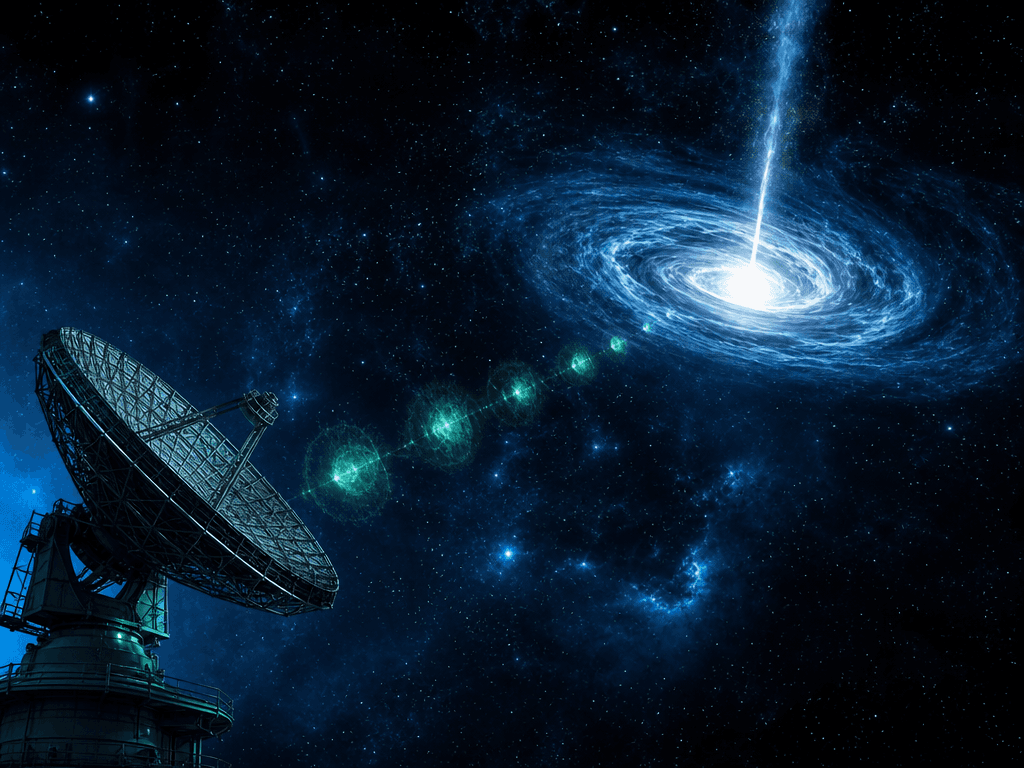
Supermassive black holes reside at the center of most galaxies, exerting significant influence over their host environments. When these gravitational giants actively consume surrounding gas and dust, they form a high-temperature accretion disk that emits immense radiation. This process creates a quasar, an object so luminous it can outshine the combined light of all stars within its host galaxy.
Gene Leung, a postdoc at the MIT Kavli Institute for Astrophysics and Space Research, led the effort to isolate the signal from archival data. The team utilized observations from NASA’s Near-Earth Object Wide-field Infrared Survey Explorer, or NEOWISE, which provided a 14-year record of infrared sky scans. This long-term dataset allowed researchers to account for the effects of cosmic expansion, which stretches light into redder wavelengths and distorts temporal patterns.
The researchers observed the quasar flickering with a random, candle-like intensity over the 14-year period. By analyzing the fluctuations across different wavelengths, the team mapped the temperature distribution of the material orbiting the black hole. This data revealed that the accretion disk is surprisingly flat and thin, a configuration typically associated with older, more stable systems.
The discovery challenges existing cosmological models that suggest early black holes should exist in a chaotic, unsettled state. A flat accretion disk implies a level of maturity that scientists previously assumed would require billions of years to develop. This finding indicates that the rapid growth phases of supermassive black holes likely occur much earlier in cosmic history than current theories predict.
Kishalay De, a former MIT postdoc now at Columbia University, played a key role by launching the project to re-process the archival NEOWISE data. This technical effort was essential to uncovering the faint signal, which had remained hidden within the noise of the vast infrared survey. The team successfully confirmed the object as the earliest flickering quasar ever recorded, marking a significant milestone in observational cosmology.
The researchers estimate the quasar possesses a luminosity equivalent to 12 trillion suns, with a flicker intensity fluctuating by approximately 20 percent. This variability acts as a diagnostic tool, allowing astrophysicists to understand the specific feeding mechanisms of the early universe. By tracking the light across various wavelengths, the team confirmed that the material closest to the black hole reached the highest temperatures, consistent with modern accretion models.
Anna-Christina Eilers, assistant professor of physics at MIT, notes that the observation suggests a specific evolutionary timeline for galactic engines. The team emphasizes that the presence of such a structure so early in the universe forces a re-evaluation of how these systems transition from their initial formation to a stable, luminous state. This provides direct evidence that the same feeding processes observed in the nearby universe were already in place at very early times.
Supermassive black holes function as the primary engines of galactic development, regulating star formation and overall structural growth. Without these central entities, galaxies would lack the coherent morphology observed in the modern universe. The existence of a mature-looking quasar at such an early epoch indicates that the most intense periods of black hole development occur in a very compressed timeframe.
If these systems reach structural maturity within 850 million years, the processes governing their initial mass accumulation must be more efficient than previously modeled. This discovery provides a new benchmark for understanding the conditions that allowed the first supermassive black holes to emerge. The findings suggest that the messy, rapid growth phases expected of young black holes occur before they become visible as luminous quasars.
Future research aims to identify even earlier examples of quasar activity to capture the transition from chaotic growth to stable accretion. By observing these objects at different stages of their development, scientists hope to reconstruct the environmental factors that enabled such rapid maturation. The team continues to analyze deep-space data to pinpoint the precursors to these ancient, luminous giants.