Astronomers have identified a magnetic skeleton that directs the flow of interstellar gas into the DR21 stellar nursery, a high-mass star-forming region located within 5,000 light-years of the sun. This discovery, published in The Astrophysical Journal, provides evidence that magnetic fields function as a structural guide for the assembly of massive stars.
The research team, led by scientists at the MIT Haystack Observatory, utilized data from the Stratospheric Observatory for Infrared Astronomy, or SOFIA, to trace these fields. The study focused on the DR21 Main Ridge, a dense filament spanning 13 light-years that contains approximately 20,000 times the mass of the sun in molecular gas cooled to temperatures below -424 degrees Fahrenheit.
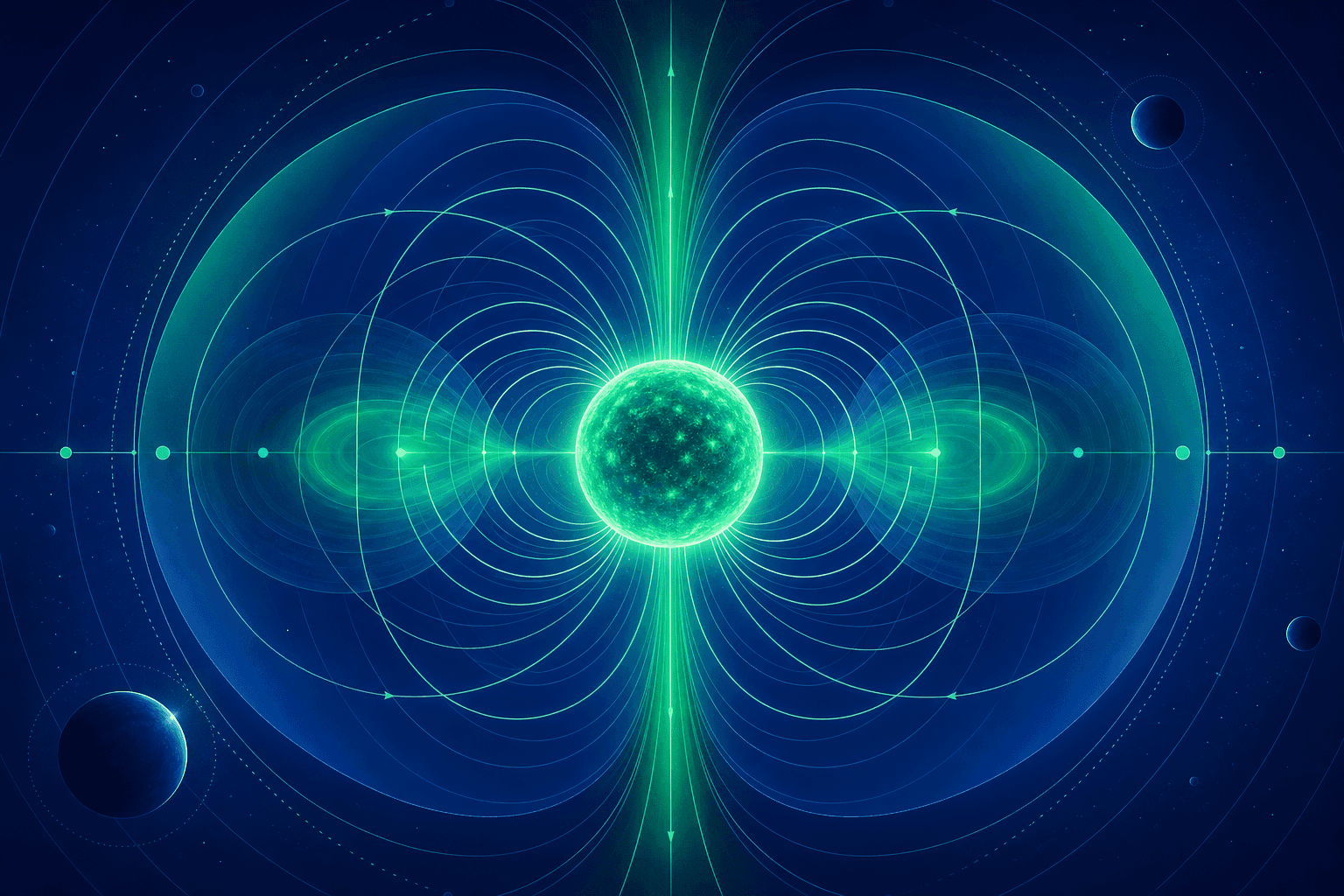
Thushara Pillai, a research scientist at MIT Haystack Observatory and the study’s lead author, described the magnetic field as a set of railroad tracks. Gas flows along these tracks toward the central ridge, while the field resists motion across the tracks, effectively channeling material into the star-forming region.
Jens Kauffmann, a research scientist at MIT Haystack Observatory and lead scientist of the astronomy group, spearheaded the data reduction process for the SIMPLIFI project. The team had to develop new methods to characterize data reduction systematics from scratch to create a homogeneous map of the magnetic field across the entire complex, utilizing the unique polarization capabilities of the SOFIA platform.
The researchers found that gravity and magnetic fields are consistently aligned throughout the cloud, a signature of magnetically guided accretion. This alignment suggests that gas streams inward along magnetic field lines toward the center of mass, facilitating the rapid assembly of the Main Ridge structure within the turbulent Cygnus X complex.
The study estimates that sub-filaments channel material into the Main Ridge at a rate sufficient to assemble its massive central structure within approximately one million years. This mechanism explains why gas appears to move slower than gravity would predict, as much of the motion occurs in the plane of the sky rather than along the line of sight.
The team compared the directions of the magnetic field, the local gravitational pull, and the gas structures themselves to confirm this hypothesis. They determined that the gas is not moving slowly, but rather is moving sideways across the observer’s view, which masks the true velocity of the accretion flow within the dense molecular filament.
The findings resolve a long-standing discrepancy regarding the speed of gas accretion in stellar nurseries. By accounting for the orientation of the magnetic field, the team demonstrated that the observed slow motion is an artifact of the viewing angle rather than a lack of gravitational acceleration.
The reliance on SOFIA, which was retired in September 2022, highlights a significant gap in current astronomical capabilities. Without a comparable facility, researchers face limitations in observing fainter emissions and larger areas of the sky to confirm these findings across different evolutionary stages of star formation.
Pillai emphasized that understanding the role of magnetic fields across the galaxy necessitates a new space-based far-infrared mission with polarization capabilities. Such an instrument would allow for a more comprehensive analysis of how these invisible scaffolds influence the lifecycle of molecular clouds.
The development of future far-infrared observatories remains a critical objective for the next decade of astrophysical research. Establishing this infrastructure is essential to determine whether the magnetically guided accretion observed in DR21 is a universal feature of high-mass star formation or a localized phenomenon.
The work was supported by a NASA award issued by the Universities Space Research Association and the National Science Foundation. These findings provide a foundational framework for future studies into the complex interplay between gravity and magnetic fields in the interstellar medium.