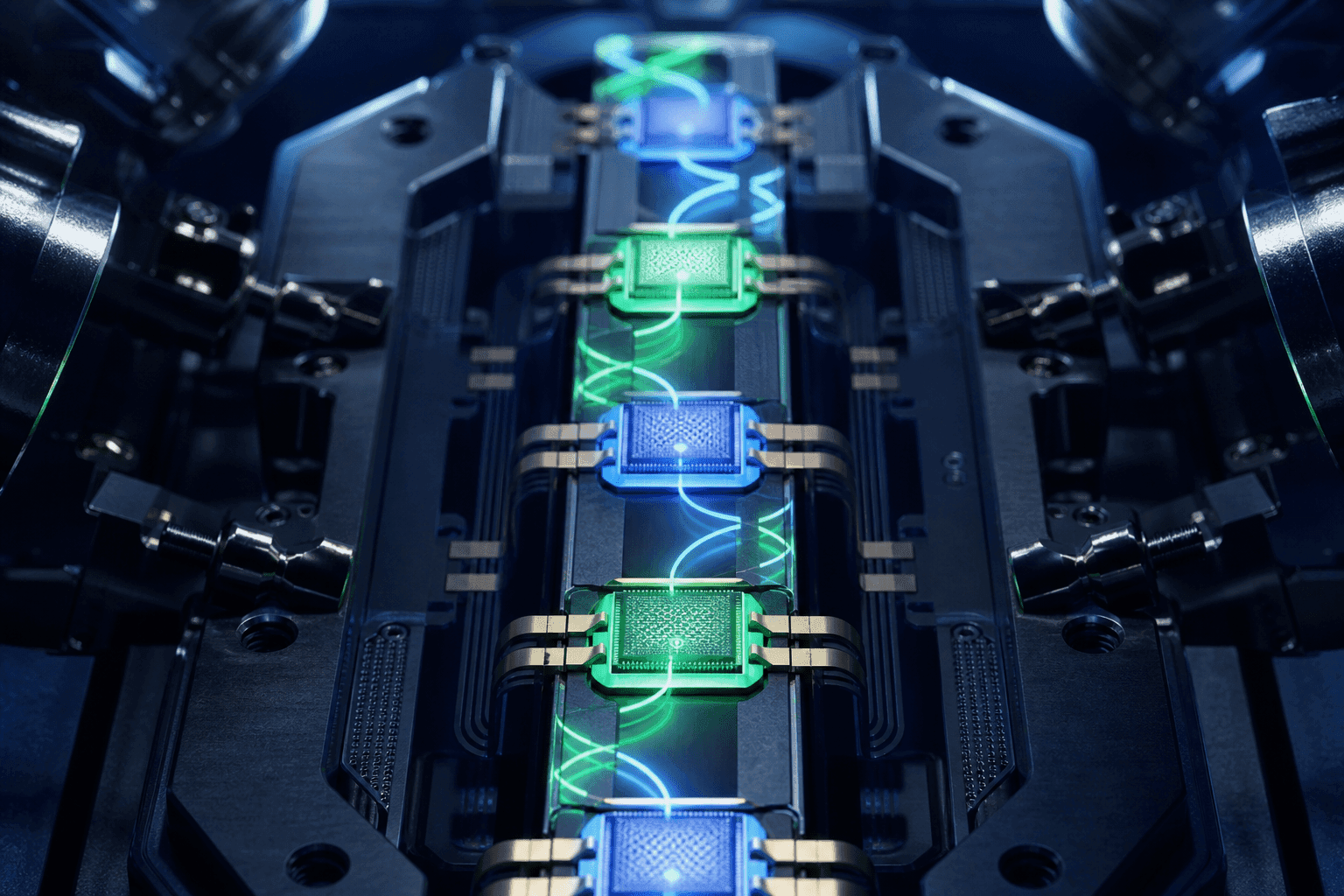
A quantum computing architecture based on ultracold neutral atoms has reached a significant technical milestone by demonstrating the ability to perform repeated error correction during sustained computations. This development, reported by researchers at Atom Computing, suggests that neutral-atom systems are maturing into a viable alternative to the superconducting circuit designs currently championed by industry leaders like Google and IBM.
The fundamental challenge in quantum computing remains the inherent instability of qubits, which are highly susceptible to environmental interference that causes computational errors. To mitigate this, scientists employ error correction protocols that distribute information across multiple physical qubits to create a more stable logical qubit. Ben Bloom, a lead researcher at Atom Computing, and his team successfully scaled their error correction groups from 16 to 32 qubits while simultaneously reducing the overall error rate.
This scaling achievement indicates that increasing the density of qubits does not necessarily lead to a proportional increase in system noise, a common bottleneck in previous hardware iterations. The experiment involved running the quantum computer through 90 consecutive cycles of error detection and correction. By monitoring specific alert-system qubits, the team verified that the machine could maintain its state through repeated operations without catastrophic failure.
The methodology mirrors recent advancements in the broader quantum field, where researchers have sought to prove that qubit counts can grow while error rates decline. In 2023, Google demonstrated this dual capability in superconducting systems, followed by similar results from the University of Science and Technology of China in 2025. A separate team at Harvard University achieved parallel success in 2025 using a different neutral-atom platform, further validating the potential of this specific hardware approach.
Bloom noted that the primary objective was to demonstrate the capacity for indefinite error correction, a goal that requires high-fidelity operations across large qubit arrays. The team focused on the physical mechanisms that allow for the detection of errors without disrupting the underlying quantum state. By refining the control systems for these neutral atoms, the researchers managed to maintain operational integrity across 90 cycles of checking, a duration that exceeds many previous benchmarks in the field.
The team also addressed the logistical challenge of managing larger qubit groups, which typically introduces complexity that can degrade performance. By successfully transitioning from 16-qubit to 32-qubit groups, the researchers proved that their architecture can scale without a corresponding loss in fidelity. This result provides empirical evidence that the neutral-atom approach is capable of supporting the complex error-correction codes necessary for fault-tolerant computing.
Jeff Thompson, a researcher at Princeton University, noted that the Atom Computing experiment represents a comprehensive integration of the necessary physical mechanisms required for a functional neutral-atom computer. He described the work as a highly sophisticated technical achievement that effectively consolidates disparate capabilities into a single, cohesive platform. Despite this success, Thompson emphasized that further refinements in computational speed and baseline error rates are required for practical application.
Mark Saffman at the University of Wisconsin-Madison observed that while the system successfully navigated 90 rounds of error correction, minor errors did accumulate over the duration of the test. This accumulation highlights the persistent gap between current prototypes and the ideal of a continuously operating quantum processor. Saffman acknowledged that the progress is nonetheless a meaningful step toward achieving the reliability standards found in conventional computing.
The significance of this research lies in its potential to challenge the dominance of superconducting qubit architectures. By demonstrating that the physical limitations once thought to hinder neutral-atom systems are surmountable, the team has positioned their technology as a formidable competitor in the race toward fault-tolerant quantum computing. The ability to perform reliable, long-running calculations is a prerequisite for tackling complex problems in material science, drug discovery, and advanced cryptography.
Industry observers anticipate that the coming years will see accelerated development cycles as these competing hardware approaches converge on similar performance benchmarks. Bloom stated that his team is already focused on mitigating the remaining error accumulation to enhance the system’s longevity. Future milestones will likely involve increasing the number of logical qubits and extending the duration of error-corrected operations to demonstrate utility in real-world industrial settings.