A seven-member international research team has demonstrated that a chain of superconducting qubits, when coupled in a specific alternating pattern, can structurally eliminate phase noise. Published in npj Quantum Information on August 15, 2026, the study proposes a hardware-level solution to one of the most persistent obstacles in quantum computing: the degradation of quantum information through environmental interaction.
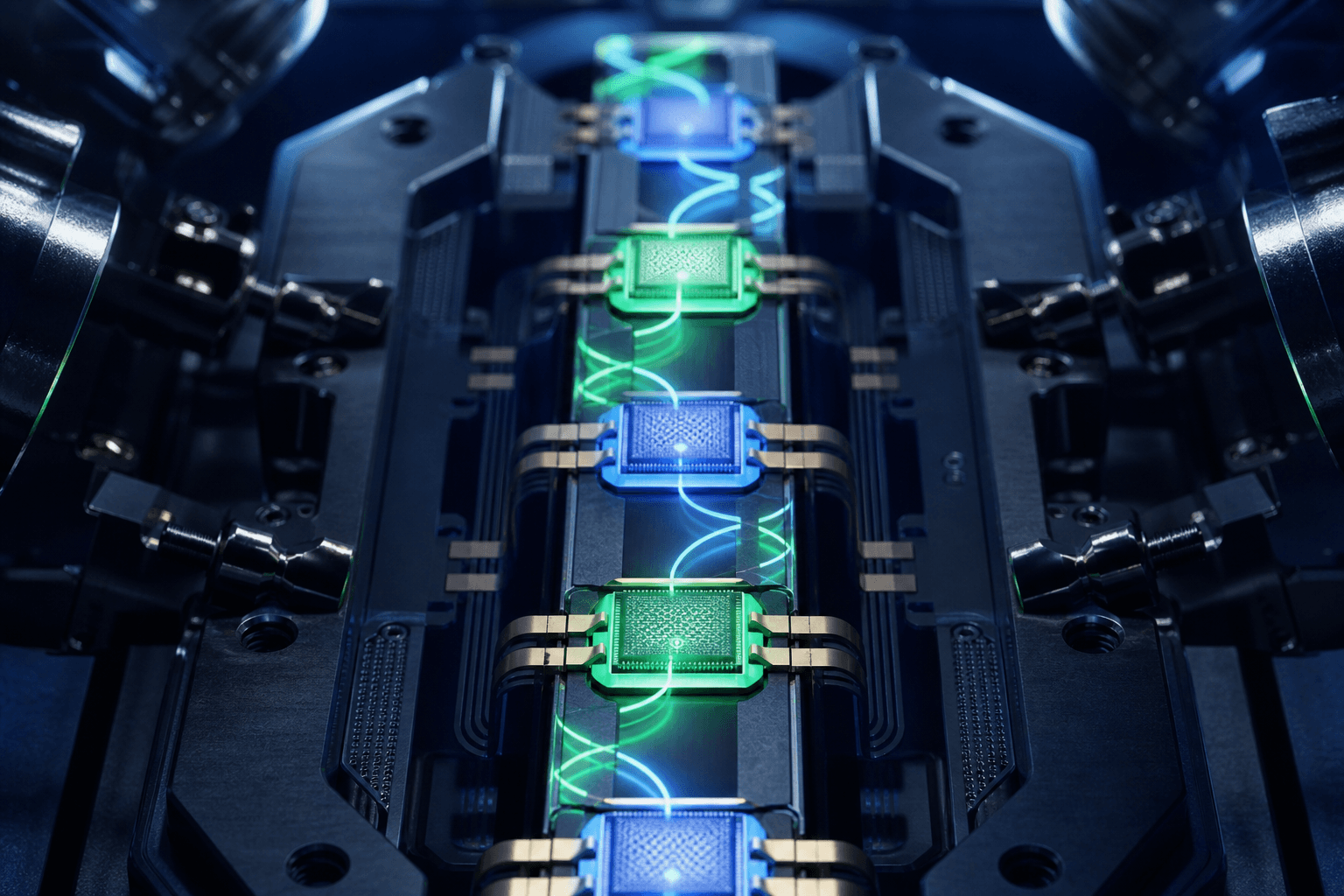
The collaboration, which includes researchers from the University of Messina, RIKEN, Adam Mickiewicz University, Fuzhou University, and the University of Michigan, focused on the interaction between neighboring qubits. By alternating between XX and YY ultrastrong coupling regimes, the team created a symmetry within the system’s Hamiltonian that effectively shields the logical qubit from the noise operators responsible for dephasing. This design ensures that the phase noise collapses to zero, fundamentally altering the error budget of the quantum system.
The mathematical structure of this Hamiltonian is central to the breakthrough. By alternating the coupling axes, the researchers introduced a parity-based symmetry that prevents the logical state from coupling to the low-frequency flux and charge noise that typically causes T2 dephasing. This symmetry is not merely an approximation but becomes exact as the system enters the ultrastrong coupling regime, where interaction strengths exceed ten percent of the characteristic resonance frequencies.
Quantum hardware typically suffers from two primary failure modes: T1 relaxation, where energy is lost to the environment, and T2 dephasing, where phase coherence between quantum states is compromised. Standard fault-tolerant architectures address these issues through quantum error correction, which requires encoding one logical qubit across hundreds of physical qubits to detect and fix errors. The proposed chain design bypasses this overhead by making the dephasing process physically impossible within the architecture.
The researchers utilized the ultrastrong coupling regime, where the interaction strength between quantum elements reaches at least ten percent of the system’s resonance frequencies. In this regime, standard weak-coupling approximations fail, allowing for the emergence of new physical properties like virtual photon populations. The team previously established the efficacy of this regime in a 2020 study, which proposed a scalable architecture built around dispersively coupled quantum buses.
Validation of the design was conducted using QuTiP, the open-source Quantum Toolbox in Python. Simulations confirmed that the logical qubit maintains high fidelity for both single-qubit and two-qubit gates, which is a prerequisite for universal quantum computation. The study also indicates that the protective effect scales positively as engineers either increase the coupling strength or extend the length of the qubit chain.
The practical implementation of this design relies on achieving ultrastrong YY coupling, which remains an experimental challenge. While XX coupling via inductive Josephson junctions is well-documented in superconducting circuits, the capacitive coupling required for YY interactions has not yet reached the necessary thresholds in laboratory settings. The researchers note that flux qubits connected through shared capacitors represent the most viable path toward a physical demonstration of this protective symmetry.
Eliminating dephasing reduces the complexity of quantum error correction from a two-dimensional problem to a one-dimensional one, focusing solely on T1 relaxation. This shift could significantly lower the number of physical qubits required to maintain a stable logical qubit, as the system no longer needs to dedicate resources to correcting phase-related errors. The ability to leverage two independent engineering levers—coupling strength and chain length—provides flexibility for hardware designers working with different fabrication constraints.
The broader implications for quantum architecture are significant, as the industry currently faces a scaling bottleneck due to the massive physical-qubit overhead required for error correction. By embedding noise protection directly into the hardware geometry, the team provides a blueprint for more efficient, stable quantum processors. Future research will likely focus on the experimental realization of the YY coupling component in superconducting flux-qubit circuits to verify these theoretical predictions in a physical chip.
This research highlights the necessity of moving beyond standard error-correction protocols toward hardware-intrinsic solutions. By addressing the fundamental physics of noise coupling at the design phase, the team has opened a pathway to reducing the physical resource requirements for future quantum computers. The transition from theoretical proposal to experimental validation remains the final hurdle for this promising architecture.