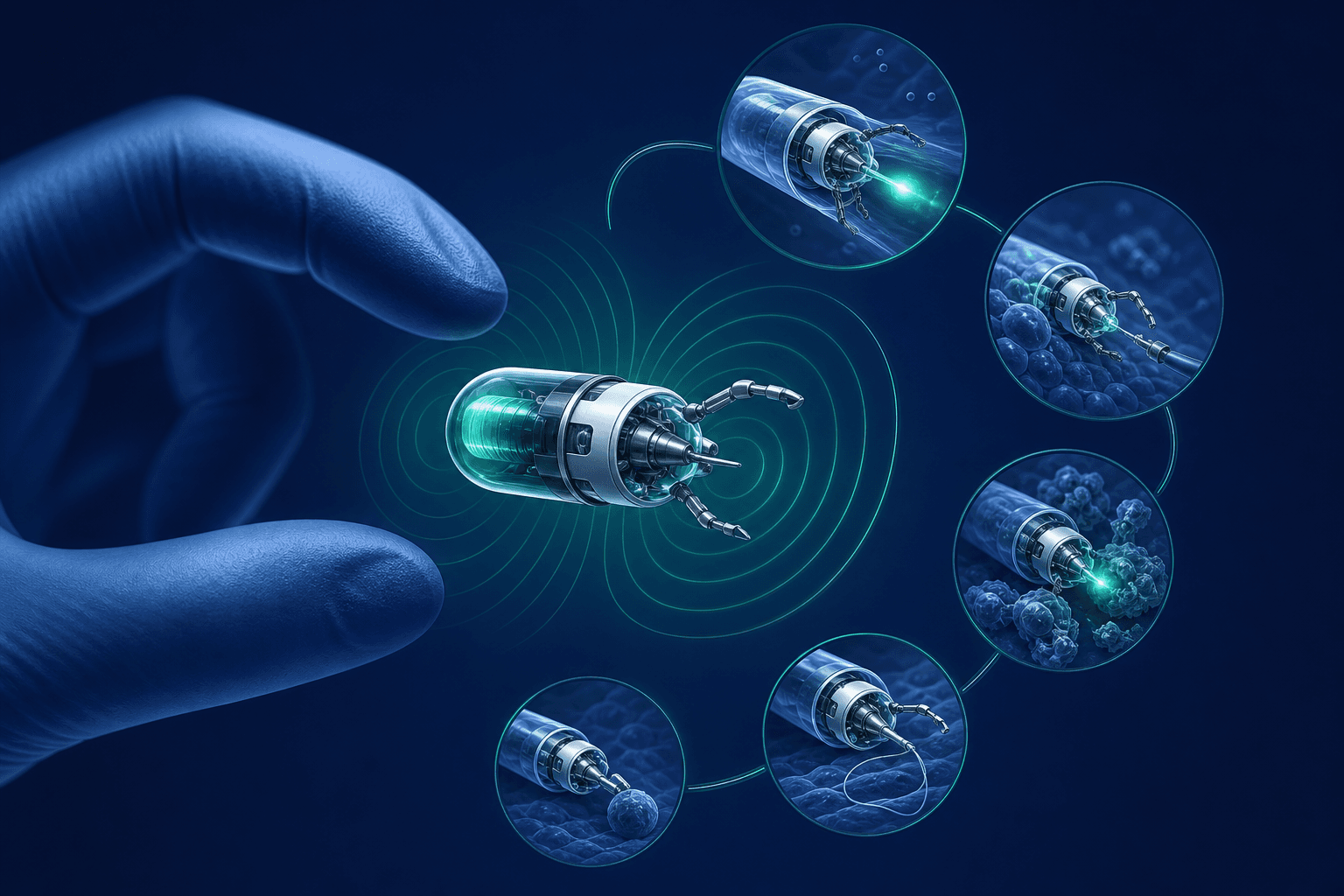
Engineers at Nanyang Technological University, Singapore, have engineered a seed-sized robotic device capable of navigating soft biological tissues to perform five distinct surgical operations. Measuring just 4.4 millimeters in length, the robot operates through the application of external magnetic fields, allowing for precise, minimally invasive medical interventions.
Associate Professor Lum Guo Zhan, who leads the research at the university’s School of Mechanical and Aerospace Engineering, developed the device to address the functional limitations inherent in current miniature robotics. The findings were recently documented in the journal Advanced Materials, detailing how the robot can transition between cutting, drug delivery, tissue sampling, and localized heating in under one second.
The robot is constructed from flexible silicone-based materials, specifically PDMS and Ecoflex, which are embedded with magnetic microparticles measuring five micrometers each. This composition allows the device to maintain a solid yet pliable structure that is significantly more durable and easier to retrieve than traditional soft-bodied, slime-like counterparts.
A central magnetic module serves as the control hub, allowing for rapid magnetization, demagnetization, and remagnetization in varying directions. Each specific magnetic orientation triggers a unique mechanical response, enabling the robot to perform multiple tasks without requiring separate hardware for each function.
This design overcomes the common challenge in micro-robotics where magnetic fields typically influence the entire device simultaneously rather than individual components. The research team engineered the robot so that specific regions respond to magnetic fields while others remain stationary, providing a level of control previously unattainable at this scale.
The device incorporates a sixth degree of freedom, rolling, which allows it to rotate around its long axis for improved navigation through complex, irregular anatomical spaces. Laboratory testing confirmed the robot’s efficacy using biological tissue models, including chicken liver and gelatin-based substrates.
The device successfully executed cutting maneuvers, dispensed drug-simulating particles, and performed tissue biopsies during these controlled trials. To address potential therapeutic applications, the researchers utilized high-frequency alternating magnetic fields to induce localized heat within the device.
This mechanism mirrors the principles of magnetic hyperthermia, a technique currently under investigation for its potential to target and destroy cancer cells without damaging surrounding healthy tissue. Biocompatibility assessments were conducted by exposing the robot’s materials to human skin cells, with results indicating that over 99 percent of the cells remained viable.
This high survival rate suggests that the materials are largely non-toxic, a critical requirement for any device intended for future clinical deployment within the human body. The significance of this development lies in its potential to refine minimally invasive surgery, reducing the need for large incisions and bulky instrumentation.
By enabling precise, localized treatment deep within the body, these miniature systems could fundamentally alter current interventional radiological procedures. Dr. Yeo Leong Litt, a senior consultant at the National University Hospital, noted that the ability of these robots to traverse complex environments while delivering medication or performing biopsies represents a notable advancement in medical technology.
He suggested that such systems could eventually function as a primary mode of therapy, replacing more invasive traditional methods. The research team, including co-authors Dr. Chelsea Shan Xian Ng, Yu Xuan Yeoh, and Nicholas Yong Wei Foo, is now focusing on integrating the robot with advanced imaging and sensing systems.
Future iterations will likely be tested against clinically realistic artificial organ models to better simulate the physical behavior of human tissue. Associate Professor Lum Guo Zhan is currently collaborating with surgeons to determine how these robotic systems can be integrated into existing clinical workflows.
The next phase of development will prioritize the refinement of guidance and monitoring techniques to ensure the technology remains effective in realistic, high-stakes medical settings. These advancements aim to bridge the gap between laboratory prototypes and practical, life-saving clinical applications.