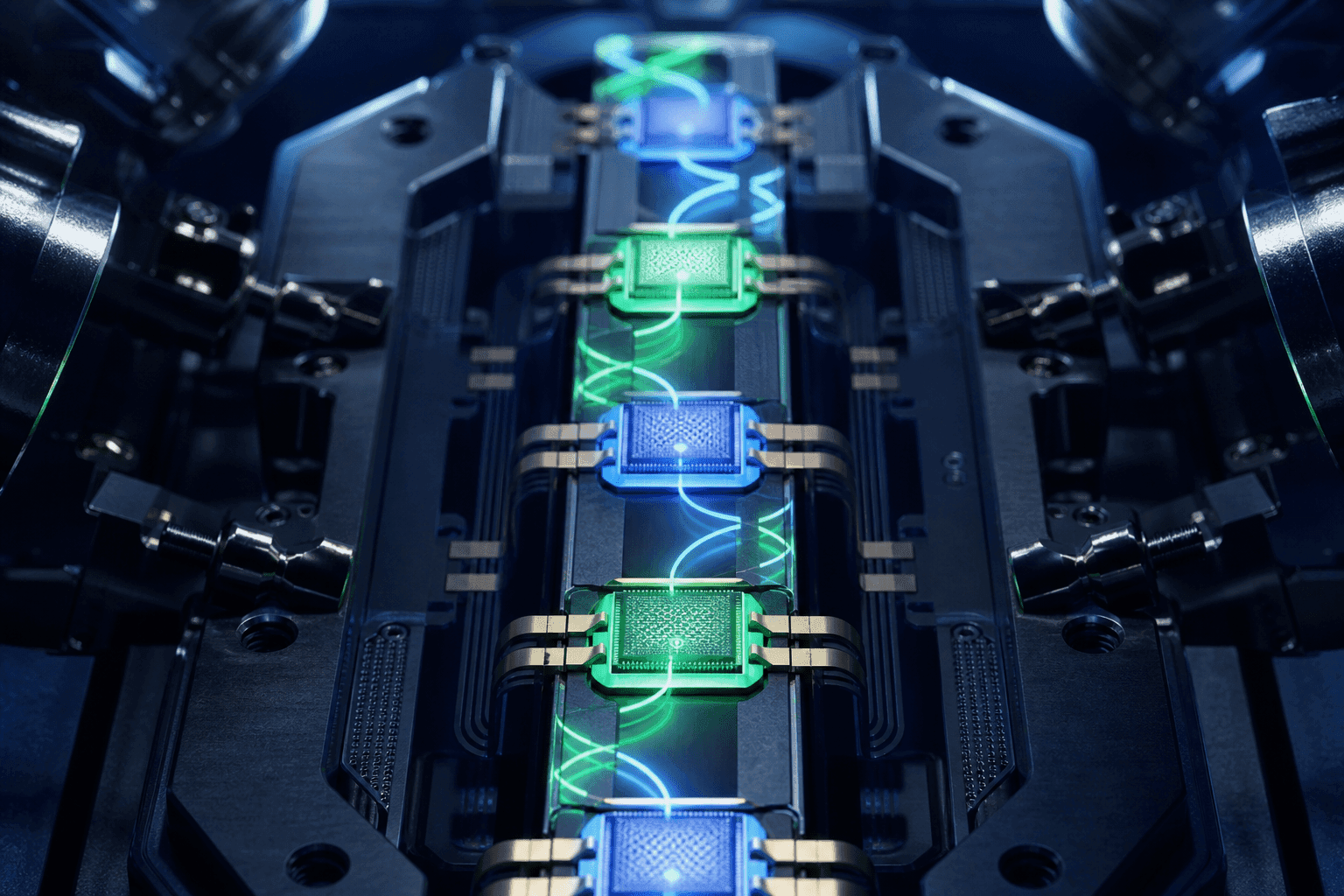
In the quiet heartland of Henan province, a new and formidable engine of scientific discovery has roared to life, signaling a seismic shift in the global technology landscape.
On April 14, China inaugurated what it proudly declares to be its largest artificial intelligence computing cluster in Zhengzhou, a feat made all the more striking by its complete independence from American technology.
This is not merely an infrastructure upgrade; it is a declaration of technological sovereignty, a tangible manifestation of Beijing’s determined push for self-reliance in the face of escalating geopolitical pressures.
The scale and speed of this development are remarkable.
In a mere two months, the Zhengzhou cluster doubled its immense capacity, expanding from 30,000 to a staggering 60,000 AI accelerator chips.
What truly distinguishes this behemoth, however, is its origin story: every single component, from the foundational silicon chips and the intricate high-speed interconnects to the complex software that orchestrates its operations, is produced domestically.
Developed by Chinese firm Sugon, this entire stack represents a meticulously constructed, fully self-reliant ecosystem, meticulously designed to bypass any potential choke points or technological blockades from external powers.
For Beijing, the message is clear: its scientific future will no longer be held hostage by foreign suppliers.
This colossal computing power is not being channeled into the realms of conversational AI or consumer applications.
Instead, its focus is intensely specialized, dedicated entirely to the “AI for Science” movement—a focused endeavor to accelerate fundamental scientific discovery.
The implications are profound and immediate across multiple critical sectors.
At the national Changping Laboratory, for instance, the cluster is already reshaping the landscape of drug development.
Protein-folding simulations, once a monumental challenge that could consume a lifetime of research, are now being completed in a matter of days.
This dramatic acceleration has the potential to unlock rapid medical breakthroughs, fundamentally altering the pace at which new treatments and cures can be identified and brought to market.
The transformative impact extends far beyond medicine.
In materials science, researchers are leveraging the cluster’s capabilities to screen and evaluate novel elements in days rather than years, promising a revolution in the development of next-generation materials for industries ranging from electronics to construction.
Aerospace engineers are pushing the boundaries of simulation, concurrently modeling the turbulence across trillions of atmospheric grids, an undertaking that promises to refine aircraft design, enhance meteorological predictions, and advance space exploration.
To further democratize access to this unprecedented power, Sugon has launched OneScience, an all-in-one development platform pre-loaded with dozens of scientific models and datasets.
This initiative aims to equip a broader spectrum of Chinese scientists, even those without deep computer programming expertise, with world-class computing tools, effectively lowering the barrier to entry for complex AI experiments and fostering a wider culture of innovation.
This strategic triumph for China unfolds against a backdrop of intensifying technological rivalry with the United States.
Beijing’s successful activation of a domestically sourced, high-performance AI hub directly addresses and effectively circumvents the constraints imposed by global GPU shortages and the strict U.S. export bans on advanced chip technology.
By insulating its scientific progress from external geopolitical pressure, China has scored a significant strategic victory, demonstrating its capacity to forge ahead with indigenous innovation even under restrictive conditions.
The U.S., keenly aware of China’s accelerating pace, has not been idle.
Lawmakers recently proposed legislation to tighten global export controls on advanced chipmaking equipment, seeking to align allies like Japan and the Netherlands with American restrictions within 150 days.
Simultaneously, the Department of Energy launched its “Genesis Mission,” an ambitious initiative to build a unified AI platform across 17 national laboratories, leveraging federal data to train scientific models and deploy AI agents capable of automating research and accelerating scientific development.
The emergence of two distinct and increasingly decoupled technological ecosystems—one Western-aligned, the other Chinese-led—marks a pivotal moment in global affairs.
China’s move towards fully sovereign infrastructure is not just about avoiding immediate sanctions; it’s about securing long-term technological independence, ensuring that its trajectory of scientific and economic advancement is not dictated by external powers.
This decoupling has profound implications, potentially fragmenting global standards, supply chains, and even scientific collaboration.
While the immediate gains for China are undeniable—enhanced security for sensitive research, insulation from geopolitical risks, and a tangible boost to its “AI for Science” agenda—the long-term viability and competitiveness of a fully indigenous tech stack, operating in isolation from dominant global standards and innovations, will remain a critical test.
As the U.S. and its allies double down on their efforts to maintain technological superiority, China’s Zhengzhou cluster stands as a potent symbol of its resolve, signaling an escalating tech cold war where the race for scientific discovery is increasingly intertwined with national security and geopolitical dominance.
The future of global innovation may well be defined by the parallel paths now being forged in the world’s leading technological powers.